
FORCES NETWORK community SURVEY REPORT: THE STATE OF THE 24 WEEKS DGR MANAGEMENT COURSE


A survey of the Forces Network community's own placement outcomes, curriculum experience and perceived value of the Directorate General Resettlement (DGR) 24-Week Management Course — reported directly by veteran officers who attended it.

Survey conducted 26 July –28 August 2026 | Anonymous, self-reported responses | Forces Network Community Survey

W H Y T H I S S U R V E Y W A S R U N ?
Gauging the Real-World Return of the DGR 24 weeks management Course
The 24-Week Directorate General Resettlement (DGR) Management Course, delivered
through institutes such as the IIMs, MDI,FMS and IIFT, is one of the most widely used bridges between military service and a civilian second career. For many transitioning officers
it is presented as a pivotal step — yet little independent, community sourced data exists on what it actually delivers in terms of placement, curriculum relevance, and value for
time invested.
Forces Network— a community of over 7,000 retired Indian commissioned officers, now
in its 19th year — ran an anonymous survey between 26 July and 28 August 2026 to gather
first-hand, peer-reported experience from officers who have completed the course. The
survey was distributed through the Forces Network community, LinkedIn and WhatsApp, and drew 181 responses from officers who attended the course across institutes and years
between 2006 and 2026.
This report presents the aggregated, anonymised findings exactly as reported by
respondents. It does not represent the views of any single institute, the DGR
or Forces Network itself, and it does not attempt to adjudicate whether the course is
"worth it" — that judgement is left to the reader, informed by what the community
itself has said.

What the Survey Asked
Respondents were asked about their service background, the institute and dates of their course, their primary purpose in attending, whether they secured a campus placement and whether the resulting compensation met expectations, the level of institute support they received, whether they felt the curriculum was aligned to industry needs, and — in hindsight — whether the six months were the best use of their time and whether they would recommend the course to another officer.
How to Read This Report
All figures are self-reported and anonymous.
Forces Network has not independently verified individual placement outcomes or CTC figures against institute records.
This is a self-selected sample, not a random or census survey of all officers who have
attended the course. Findings describe this respondent group and should not be read
as a definitive, nationally representative statistic.
"n" denotes the number of respondents behind a given figure. Where a sub-group is small, this is called out explicitly so the reader can weigh the finding accordingly.
A full note on sample composition and limitations is provided at the end of this report.
T H E H E A D L I N E N U M B E R S
What 181 Officers
Told Us


Placement Outcomes Have Declined
Sharply Since 2021
Personal campus placement rates have fallen steadily across the three periods
this report tracks: from 43% for officers who completed the course up to 2015 (n=63), to 27% for 2016–2021 (n=33), to 20% for 2022–2026 (n=85). The decline is most pronounced
in the most recent, largest, and best-represented block of the sample: among the 65
respondents whose courses ended between 2024 and 2026, only 15% reported a personal campus placement.
Institute Support/PLACEMENT CELL ZEST Is the Strongest Correlate
of Placement
Officers who said their institute "fully supported" the placement process were placed at 48%
compared with 39% for "some support" and just 16% for "no support at all."
The share of respondents reporting "no support at all" has itself risen — from around 42% for pre-2022 courses to 55% for 2022–2026 courses.
Perceived Value Persists Even Where Placement Does Not
Despite the placement decline, sentiment on the course's broader value has not collapsed in step. The share who would recommend the course actually rose from 60% (2006–15 cohorts)
to 75% (2022–26 cohorts), and "best use of time" has stayed roughly flat at ~70% across all
three periods. Respondent comments suggest this value is now attributed less toplacement itself and more to dedicated transition time, networking, and the opportunity to pursue
independent certifications alongside the course.
Curriculum Relevance Is Softening
The share of officers who feel the curriculum is aligned to industry needs has slipped
from 59–61% for courses up to 2021 to 51% for 2022–2026 courses — consistent with recurring respondent comments describing the syllabus as generic, compressed, or dated relative to current hiring themes such as AI, cybersecurity and specialised certifications.
W H O A N S W E R E D T H I S S U R V E Y ?
Sample Composition

The 181 respondents skew toward the Indian Army (55%, n=100), followed by the Indian Navy (27%, n=49) and the Indian Air Force (18%, n=32) — broadly reflective of the relative
size of the three services and of Forces Network's own membership base.
Type of exit: Premature Retirement — PMR — accounts for the largest share of respondents
(50%, n=90), followed by Short Service exit (40%, n=73) and Superannuation (10%, n=18).
Years of military service at exit ranged from 5 to 36 years, with a mean of 18.4 years and a median of 21 years — spanning both young Short Service officers and officers who served a full career.
Respondents' courses were completed across a wide span — from 2006 to 2026 — though
the sample is naturally weighted toward more recent cohorts: 28% of all responses (51 of181)
relate to courses completed in 2024 or 2025 alone, a pattern consistent with how the survey
was distributed through current community channels.
Institutes Represented
Respondents self-reported over 20 distinct institute names, which have been standardised below for institutes with at least 6 respondents. IIM Indore is the single most-represented institute in the sample.

S E C T I O N 1 · P A R T A
Is the Course Still
Delivering Placements?
Across all 181 respondents, 29% report having personally secured a campus placement at the end of the course; 71% did not. Tracked by the year the course ended, the placement rate shows a clear downward trajectory over the past two decades — and a pronounced, sustained decline from 2022 onward.

Personal campus placement rate by year the course ended. Bubble size reflects the number of respondents for that year (n shown above each point). Years with n=1 are shown but should be read with caution.
Does the data show a "drastic dip" after 2021? Yes — the decline is real, and it steepens
the closer the sample gets to the present. Personal placement rates were 53% for 2019–2021 courses (n=15), fell to 35% for 2022–2023 (n=20), and dropped further to 15% for 2024–2026 (n=65 — the largest single block in the whole sample). Rather than a single-year cliff, the
data points to a sustained, worsening decline that began around 2022 and has continued through the most recent cohorts.
A note on 2008: the one earlier spike in the trend line (76% placement, n=25) is
concentrated almost entirely in a single institute-year — 19 of those 25 respondents
attended IIM Indore's 2008 course. It should be read as a strong single cohort's
result rather than an industry-wide peak, and is treated separately from the broader multi-year trend below.

S E C T I O N 1 · P A R T B
What Separates Officers Who Get Placed From Those Who Don't
Institute Support / Placement Committee Efforts Is the Clearest Correlate

Placement outcomes track closely with how much support respondents say their
institute provided and more importantly how active was the student placement cell. Officers reporting a fully-supportive placement cell were placed at 48%; this falls to 39% for "some support" and 16% for "no support at all".
Placement Is Not Explained by
Individual Intent or Prior
Certification
Of the 85 respondents (47% of the sample) who said their primary purpose for attending
was specifically campus placement, 28% were placed — almost identical to the 30% rate among the 96 respondents who cited other purposes (knowledge-building,networking,
time for transition, etc.). Likewise, holding an industry recognised certification (PMP,
CPP, CISSP, Az-900etc.) before placement made almost no difference: 28% of
certified officers were placed versus 30% of those without a certification. Placement, as reported here, appears to be shaped more by institutional and the efforts of the student placement cells rather than by an individual officer's stated goal or prior credentialling.
Note: There being no correlation between industry certifications and placements need to be looked at greater detail before any lasting conclusions are drawn.
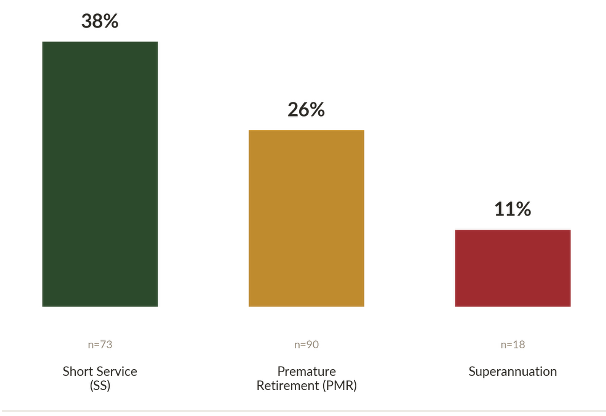
Placement rates differ noticeably by type of exit: Short Service officers — typically younger and more junior — were placed at 38%, compared with 26% for those exiting on Premature
Retirement and just 11% for officers exiting on Superannuation.
Consistent with this, respondents who secured a placement had served an average of 14.8 years, versus 19.8 years for those who did not —suggesting campus placement mechanisms
in their current form favour younger, more junior profiles.
Even Among the "Successfully" PlacedCompensation Often Disappoints
Of the 53 respondents who did secure a campus placement, only 64% said the resulting
CTC met their expectations — a figure that has stayed roughly flat across all three time
periods studied. More than a third of placements, even where they materialised,
did not meet the officer's own compensation expectations.

S E C T I O N 1 · P A R T C
Placement Outcomes Vary Widely by
Institute

Reading this chart responsibly: Sample sizes per institute are modest (6–33 respondents)
and span different year ranges— IIM Indore's result, for instance, is influenced by the
concentrated 2008 cohort discussed on the previous page. These figures describe
this survey's respondents at each institute, not a certified or audited institutional placement statistic, and should be read as directional rather than definitive.
Disclaimer: These findings cannot be said to be conclusive as the sample size across the Institutes is skewed. Also, this chart is no measure of an Institute’s standing or capability.
No institute among those with sufficient respondents both provided consistently full
placement support and eliminated the downward multi-year trend seen in Part A —
the decline in placement outcomes after 2021 appears across institutes rather than being concentrated in any single one, based on the respondents available for this survey.
S E C T I O N 2
Is the Curriculum
Keeping Pace With the Industry?
Overall, 55% of respondents feel the course curriculum is aligned with industry needs, based
on their subsequent experience working in the civilian sector. This share has softened over
time: 59% for 2006–2015 courses, 61% for 2016–2021 courses, and down to 51% for 2022–2026 courses.

What Respondents Said About the Curriculum
OFFICER, 2022COHORT
"These are certificate programmes; however these should be degrees or equivalent courses which are recognised at par [with] top courses… guidance was required in terms of profile, responsibilities, packages rather than theory."
OFFICER, 2023COHORT
"The curriculum is extremely compressed, cramming entire semesters into a month, and often relies on textbooks written by in-house faculty,
which feels self-serving and
outdated rather than industry-aligned."
OFFICER, 2025COHORT
"The course has been curated
well with basics of corporate knowhow, but it does not
directly prepare a transitioning office to enter into the corporate
world."
OFFICER, 2007 COHORT
It is important to consider the changing technology trends and align as per the emerging needs.
In today’s context it will be good to include details of industry oriented certifications eg. AI - how to leverage on to that in any organisation and the role, role of cloud infra in cost optimisation and operational efficiency improvements etc.
OFFICER, 2012–20 COHORT
We are trained Management Professionals by virtue of serving the Army. This Course should focus on helping us tweak our already existing Managerial Skills according to the same required on the Civvy Street. The people setting the Curriculum should clearly identify the Gaps in the Skill set and then so design the Curriculum. It is strongly recommended that the Institution's placement infrastructure should whole heartedly support the transitioning officers".
OFFICER, 2024 COHORT
"DGR should have MoUs with Public / Pvt / MNCs with majority of the companies for OJT/ Internship to help the retiring officers/ PBORs/ men/ veterans."
"Retiring officers need mentorship from previous seniors who transitioned to help them re-position themselves in the civil world based on their strengths, skill sets and experience."
A recurring theme across comments — both from officers who would and would not
recommend the course — is a preference for the curriculum to be more specialised (aligned
to a target function or industry) and supplemented with, or replaced by, recognised professional certifications (e.g. PMP, CPP, cloud and AI-related certifications) rather than a generalist
management syllabus.
S E C T I O N 3
Was It Worth the Six Months?

Value Judgements Do Not Move in Lockstep With the Placements
One of the more counter-intuitive findings in this survey is that, even as placement
rates have fallen, respondents' willingness to recommend the course has not fallen with
them — it has risen, from 60% among 2006–2015 respondents to 75% among 2022–2026
respondents. "Best use of time" has stayed essentially flat, at 70%, 70% and 72% respectively across the same three periods.
This pattern also holds at the individual level: 66% of respondents who did NOT get a campus placement still said the course was the best use of their time, and 65% of that same non-placed group said they would still recommend it to another officer.
Respondent comments suggest this value is attributed to factors other than placement itself — among them, dedicated time to mentally and practically prepare for transition, exposure to corporate language and culture, networking, and the opportunity to pursue independent
certifications alongside the coursework.
OFFICER, 2024–2026 COHORT · DID NOT RECOMMEND
ON PLACEMENT
GROUNDS, BUT
VALUED THE TIME
"Time away from work is critical for an individual to figure out what that individual wants to do next … the course curriculum needs improvement."
OFFICER, 2022–2026 COHORT
"I feel that the resettlement course functions
more as a revenue stream than a genuine transition support system. There's no meaningful placement
assistance… the certs that really matter are ones
pursued independently, like PMP or cloud certifications, not the course itself."
Timing and Compensation
Among the minority who were placed, satisfaction with compensation (CTC) was moderate and stable over time: 64% of the 53 placed respondents said the CTC met their
expectations, a figure that has not shifted meaningfully across the three periods (63%, 67%, 65%).

I N T H E I R O W N W O R D S
Ideas and Concerns
Officers Raised
Unprompted
The additional-comments field was optional; 140 of 181 respondents (77%) used it.
The themes below are those that recurred most often across those comments.
They are presented as a record of what respondents raised — not as
recommendations from the Forces Network.
1 Replace or supplement the generalist syllabus with
targeted certifications:
Several respondents suggested the course would deliver more value if it
were restructured around an officer's intended function or industry (HR, Finance, Cybersecurity, Admin/Security, Education management) and paired with recognised certifications, rather than a single generic management curriculum for all attendees.
2 Structured industry internships or OJT in place of, or alongside,
classroom time
A number of comments proposed that part of the six months be spent on live projects, internships, or on-the-job training with partner companies, arguing this would give officers practical exposure that classroom-only instruction does not.
3 Stronger, more accountable
institutional placement support
Given that "no support at all" is the most common support level reported (48%
of respondents) and the strongest correlate of not being placed, several
respondents called for greater institutional accountability on
placement outcomes, including named placement officers, shared recruiter
/company contact lists, and closer institute–industry tie-ups specifically for transitioning officers.
4 Value the time even where
placement does not materialise
A recurring counterpoint in the comments — including from respondents who were
not placed — was that the six months away from unit life is, in itself, a valuable
and often rare opportunity to mentally and practically prepare for a second career, regardless of whether the institute delivers a job at the end of it.
R E A D I N G T H E D A T A R E S P O N S I B L Y
Methodology, Data
Notes & Limitations
Methodology
Anonymous, self-administered online survey (Google Forms), distributed via Forces
Network's community channels, LinkedIn and WhatsApp, open 26 July–28 August 2026.
181 valid responses from officers who had attended the 24-week DGR Management
Course, across the Army, Navy and Air Force, spanning courses completed between 2006 and 2026.
All questions other than the closing comments field were single-select or short-answer; percentages in this report are calculated on the number of respondents who
answered that specific question, which is occasionally fewer than 181 (noted as "n"
throughout).
Institute names were free-text and have been manually standardised for reporting (for example, "IIM,I" / "IIM I" have been mapped to IIM Indore, consistent with the
abbreviation format given as an example in the original survey question).
Limitations
Self-selection bias. Respondents opted in via community and social channels;
officers with a strongly positive or strongly negative experience may be
more inclined to respond than those with a neutral view. This is not a random
or independently audited sample of all officers who have attended the course.
Recency Concentration. 28% of all responses relate to courses completed in 2024 or 2025
alone, giving recent cohorts more statistical weight and more granular sub-analysis than older ones.
Uneven distribution across years and institutes. Some individual years (e.g. 2021, n=3) and institutes (several with n<6) have very few respondents; period-level and institute-level figures should be read with the accompanying sample sizes in mind.
A single-cohort concentration in 2008. Nineteen of the twenty-five respondents whose
courses ended in 2008 attended IIM Indore, which is treated as a distinct data note
in Section 1 rather than folded uncritically into the broader trend.
Unverified, self-reported outcomes. Placement status, CTC satisfaction and curriculum views reflect each respondent's own account and were not corroborated against institute placement records.
Free-text fields excluded from quantitative analysis. The question asking what percentage
of an officer's batch was placed drew a mix of numeric, fractional and descriptive text answers and was too inconsistent to convert into a reliable quantitative trend; it is therefore referenced only qualitatively in this report.
disclaimer
This report presents what respondents told Forces Network, aggregated and
anonymised. It is offered as a factual account of the community's own experience, for officers weighing this course as part of their transition, and as structured feedback that may be of interest to institutional stakeholders.
Note:
This is not an institutional evaluation. This report is a survey of respondent experience, not an audit or assessment of any institute. It does not reflect, in any manner, the academic standing, quality of education, faculty competence, or accreditation of any institute named in this report. Where institute-level figures are presented, they describe the placement and satisfaction outcomes reported by this survey's respondents from that institute — they are not a certified statistic issued by, verified with, or endorsed by the institute, and should not be used to draw conclusions about the institute's overall quality or standing. This Report does not intend to rate, rank, or evaluate any institute, and this report should not be construed as doing so.


Comments